

Could Owning Land Be One of the Smartest Moves You Make?
Could Owning Land Be One of the Smartest Moves You Make?
Why savvy buyers are looking at raw land as a way to protect purchasing power, build long-term wealth, and secure a piece of their future.
Here's a question worth thinking about.
What if the biggest risk to your financial future isn't a stock market crash, a recession, or even losing your job?
What if it's simply doing nothing while your money becomes worth less and less?
Think about it.
Your grocery bill is higher. Insurance costs more. Property prices have climbed in many areas. And that dollar sitting in your savings account?
It may not buy nearly as much tomorrow as it does today.
Welcome to the world of inflation.
But here's something interesting.
While many people are focused on what inflation is taking away from them, others are looking at what they can OWN to help protect their financial future.
And one of those assets is something that's been around for millions of years.
LAND. 🌎
Not a fancy house. Not a rental property with tenants calling at midnight. Just a piece of good old-fashioned dirt.
Let's explore why owning land during an inflationary economy might be one of the smartest long-term decisions you make.
💰 1. Inflation Shrinks Your Purchasing Power. Land Gives You Something Tangible.
Let's start with a simple example.
Imagine you have $20,000 sitting in a savings account earning little or no interest.
If inflation averages 3% annually, that money would have the purchasing power of approximately $14,900 in today's dollars after 10 years.
You still have your $20,000.
But it doesn't buy what it used to.
Now imagine using some of that money to purchase a parcel of land.
Instead of holding only cash, you own a physical asset that may appreciate over time.
And unlike money, nobody can print another acre of land.
Of course, land values aren't guaranteed to increase. Location, accessibility, demand, and permitted uses all influence what a property is worth.
But owning a tangible asset can be one way to diversify your financial future rather than relying entirely on cash.
📈 2. Land Has a History of Long-Term Appreciation
Let's look at some actual numbers.
According to the USDA, average U.S. farm real estate values reached $4,500 per acre in 2026, increasing 3.4% from 2025.
Over the five-year period from 2020 through 2025, average farmland values grew at a compound annual rate of 6.8%, or 2.6% after inflation.
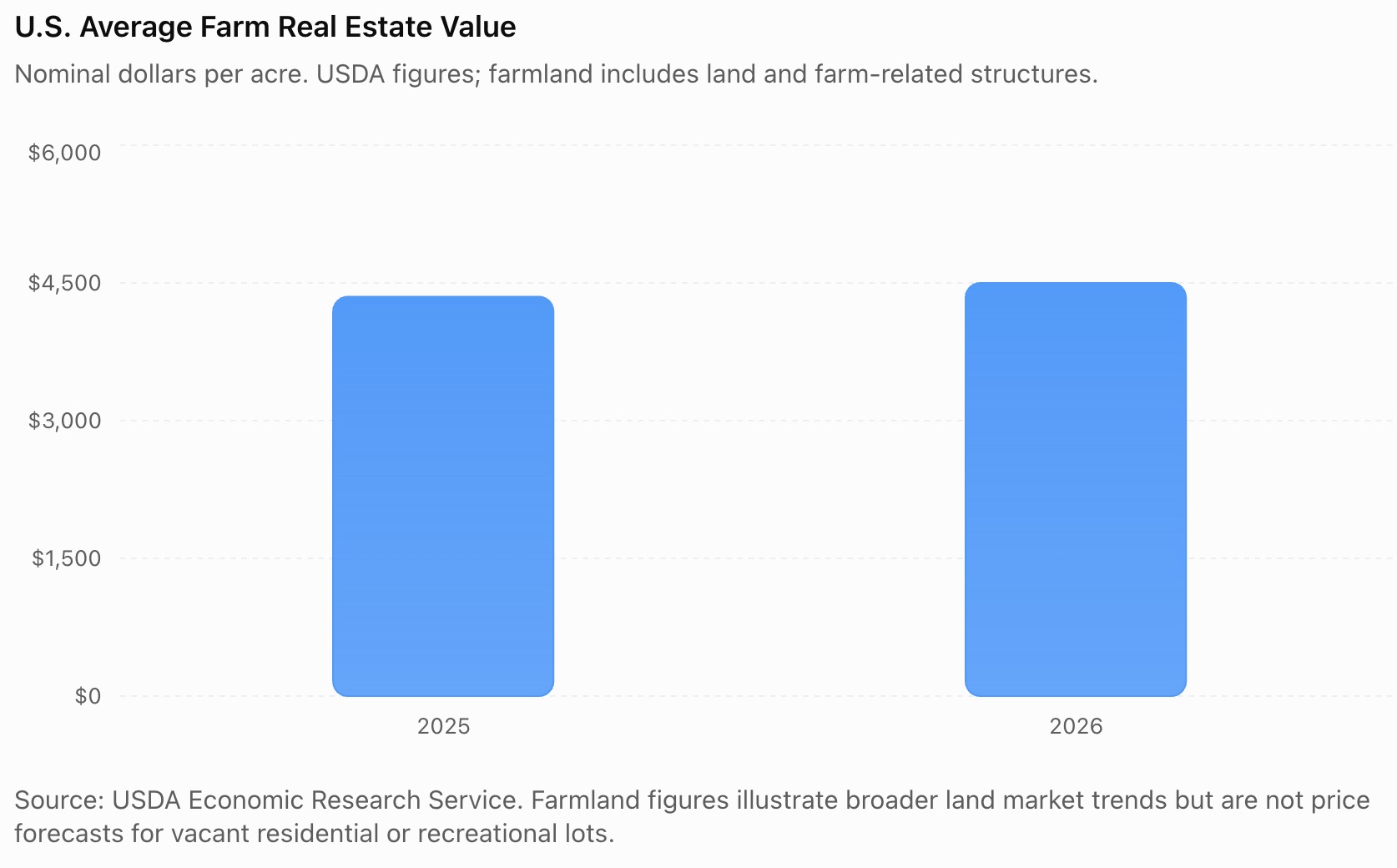
Because it demonstrates that certain types of land have historically increased in value even after accounting for inflation.
But here's the catch.
Not all land appreciates equally.
A parcel in a growing community with legal access and desirable features may perform very differently from a remote property with limited development potential.
That's why buying the RIGHT land matters just as much as deciding to buy land in the first place.
🌳 3. They're Not Making Any More Land
You've probably heard this saying before.
"They're not making any more land."
It's simple. But there's a lot of truth behind it.
The supply of land is finite.
And as communities expand, infrastructure develops, and population patterns shift, demand for certain locations can increase.
Think about areas that were once considered the middle of nowhere.
Decades later, some have become thriving residential communities, commercial districts, and desirable recreational destinations.
Now, does that mean every vacant lot is going to become a gold mine?
Absolutely not.
Some properties may never appreciate significantly. Others may have restrictions that limit their future use.
But purchasing land in an area with genuine long-term demand can create an opportunity to benefit from future growth.
The opportunity isn't just owning land. It's owning land that other people may want someday.
🏡 4. You Can Buy the Land Today and Decide What to Do With It Tomorrow
This might be my favorite reason to consider owning land.
You don't necessarily need to have every detail of your future figured out today.
Maybe you're thinking about retirement.
Maybe you've dreamed about having a weekend escape.
Maybe you'd like a place to build a home someday.
Or perhaps you simply want to own an asset that you can eventually pass down to your children or grandchildren.
Depending on the property's zoning, access, and restrictions, you may have several possibilities.
And here's where inflation becomes part of the conversation.
Imagine finding a property today that fits your long-term goals.
If land prices in that area increase over the next 10 years, securing that property now could work in your favor.
You're making a decision today that could give you more options tomorrow.
Land isn't just about what it's worth. It's also about what it makes possible.
🔑 5. You Don't Necessarily Need a Fortune to Get Started
Here's a misconception I hear all the time.
"I'd love to own land, but I don't have enough money."
That might be true if you're looking at a 100-acre ranch or a prime waterfront parcel.
But raw land ownership isn't reserved for millionaires.
Smaller parcels, especially in rural and developing areas, can sometimes be purchased for a fraction of the cost of a traditional home.
🔨 6. Raw Land Can Be Simpler to Own Than Traditional Real Estate
Want to know what I love about raw land?
No tenants. No termites. No toilets.
Think about everything that comes with owning a rental house.
The leaking roof.
The broken air conditioner.
The tenant who forgot to pay rent.
The unexpected repair bill that seems to arrive at the worst possible time.
Raw land generally doesn't have those same headaches.
There are no kitchen appliances to replace, bathrooms to remodel, or carpets to clean between tenants.
That doesn't mean land is maintenance-free.
You still need to consider property taxes, insurance when appropriate, vegetation management, legal access, and any local maintenance requirements.
And unlike income-producing rental property, vacant land typically doesn't generate monthly cash flow on its own.
But for someone who wants a more hands-off asset to hold for the long term, raw land can be an appealing alternative.
Sometimes simpler really is better.
🛡️ 7. Land Can Help Diversify Your Assets During Uncertain Times
When inflation rises, the economy can become unpredictable.
Interest rates change. Stock prices fluctuate. Consumer spending shifts.
And that uncertainty has people asking an important question:
"Where should I put my money?"
There's no single perfect answer.
Stocks, bonds, savings, businesses, and real estate all have advantages and risks.
But real assets, including certain types of land, deserve consideration as part of a diversified financial strategy.
Research has found that real estate can provide some protection against certain inflation pressures, particularly energy-related inflation, although it doesn't consistently hedge against every type of inflation. Source: NBER https://www.nber.org/digest/202209/which-asset-classes-provide-inflation-hedges?utm_source=chatgpt.com&page=1&perPage=50
The goal isn't to put all your money into dirt.
It's to consider whether owning a tangible asset might complement the investments and savings you already have.
And for some people, a modest parcel of land can be a practical place to start.
⚠️ 8. The Good, the Bad, and the Ugly of Land Investing
I believe in talking about the whole picture.
Not just the exciting stuff.
Because while land can be a valuable long-term asset, there are things every buyer should understand.
Land isn't guaranteed to appreciate. Some properties lose value or remain stagnant for years.
Land isn't always easy to sell. You may need months to find the right buyer.
Not every property is buildable. Zoning, flood zones, wetlands, utilities, and legal access can significantly affect what you're allowed to do.
There are ongoing costs. Property taxes, financing, maintenance, and other expenses can eat into your returns.
Inflation isn't automatically your friend. Rising interest rates and weaker buyer demand can put downward pressure on land prices.
Here's my advice.
Never purchase land based solely on what someone promises it will be worth someday.
Do your homework.
Know what you're buying, what you can legally do with it, and what similar properties are actually selling for.
And most importantly, make sure the investment makes sense for YOUR financial situation.
🌅 9. The Best Return Might Be More Than Financial
Let's finish with something that doesn't show up on an investment spreadsheet.
Freedom.
Options.
Peace of mind.
Imagine having a little piece of property you can call your own.
A place where you might eventually build your retirement getaway.
A recreational retreat you can enjoy with family, where permitted.
A piece of land you could pass down to the next generation.
Or simply an asset you purchased years ago that you now have the option to keep, use, or sell.
That has value, too.
Not every investment needs to be about chasing the highest possible return.
Sometimes it's about creating choices for your future.
And isn't that what building wealth is ultimately supposed to accomplish?
🌎 Final Thoughts: Your Money Is Going Somewhere. Why Not Put Some of It Into Something You Can Own?
Inflation is a reminder that the financial decisions we make today can affect the options we'll have tomorrow.
And while nobody can predict exactly where the economy or property values are headed, one thing is certain.
Doing your research and making intentional decisions beats blindly hoping everything works out.
Land isn't a magic investment.
It won't make everyone rich.
And it certainly isn't right for everybody.
But for the right buyer, purchasing the right property at the right price can be a meaningful step toward building long-term wealth and creating more financial flexibility.
You don't have to build on it tomorrow. You don't even have to know exactly what you'll do with it yet.
You just need to understand what you're buying and why it makes sense for your future.
Curious About Land Ownership?
At Green Acres Land Group, we believe owning land should be approachable, understandable, and affordable.
We offer land purchasing opportunities, including properties with flexible monthly payments, designed to help buyers explore ownership without necessarily needing to pay cash upfront.
Whether you're planning for retirement, considering an investment, or simply dreaming about having your own piece of land, we're happy to help you explore the possibilities.
No pressure. No confusing sales pitch. Just a conversation about what you're looking to accomplish.
👉 Explore available properties at GreenAcresLandGroup.com.
Here's a question for you: If you owned a piece of land today, would you hold it as an investment, save it for retirement, or use it as your own personal getaway?
We'd love to hear what you have in mind!
Got questions? We’re here to help you find the perfect


