

Who Really Owns the Treasure Beneath Your Feet?
Who Really Owns the Treasure Beneath Your Feet?
Imagine this: you buy a quiet piece of land, walk it one afternoon, and discover something shiny in the dirt. Gold? Oil? Natural gas? Suddenly your “cheap little parcel” feels like it could be worth a fortune.
But here’s the uncomfortable truth: buying land does not automatically mean you own everything under it.
In the U.S., land ownership can be split into two big categories: surface rights and mineral rights. Surface rights usually cover your ability to use the land above ground. Mineral rights cover valuable resources below the surface, such as oil, gas, coal, gold, silver, and other minerals. Those rights can be sold, inherited, leased, or reserved separately from the land itself.
So, if you “strike gold” or discover oil, the real question is not, “Who found it?” The real question is: Who owns the mineral rights?
If you bought the land and the mineral rights were included in the deed, then you may own the gold, oil, or minerals under the property, subject to state laws, permits, environmental rules, and extraction regulations. But if a prior owner kept the mineral rights, or sold them years ago, you may only own the surface while someone else owns what is underneath. That is called a split estate or severed mineral estate.
Here’s where land buyers get burned. A seller may advertise “5 acres for sale,” but that does not always mean the mineral rights are included. Sometimes the deed contains language like “seller reserves all oil, gas, and mineral rights.” Other times, the rights may have been separated decades ago and buried deep in the property’s chain of title. In some states, mineral rights owners may even have certain rights to access the surface if needed to extract the minerals.
Oil and gas get even trickier because they can move underground. Unlike a chunk of gold sitting in one place, oil and gas can migrate through underground reservoirs. Many states follow some version of the “rule of capture,” which generally means the party legally drilling and producing from a well may own what they bring to the surface, even if the oil or gas migrated from nearby land. But this area is heavily regulated and varies by state, so you absolutely do not want to wing it.
Gold is different because it is usually treated as a hard mineral, not a moving resource like oil or gas. If the gold is on private land and you own the mineral rights, you may have ownership rights to it. But if you only own the surface, or the property is subject to a prior mineral reservation, lease, or claim, someone else could have the legal right to the minerals. On federal public lands, gold and other metallic minerals fall into a different system involving mining claims, and the Bureau of Land Management says mining claims apply to certain public domain lands, not just any private property someone happens to buy.
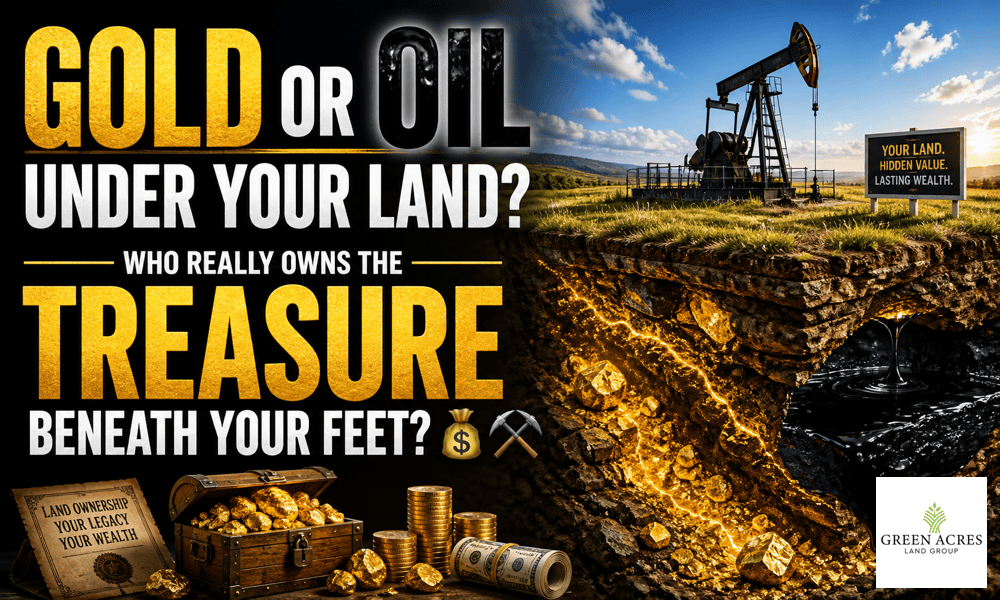
The big takeaway for land buyers is simple: do not assume dirt equals treasure. Before buying land, ask these questions:
Do mineral rights come with the property?
Are there any mineral reservations in the deed?
Has anyone leased the oil, gas, or mining rights?
Does the title search include mineral rights, or are they excluded?
Can the seller legally transfer the mineral rights, or were they already separated?
This matters even if you are buying land for camping, building, investing, or holding long term. You may never discover oil or gold, but mineral rights can affect value, future resale, and your control over the property. In mineral-heavy areas, it is especially important to have a title company, real estate attorney, or land professional review the deed history before you close. A standard title policy may not always fully protect you on mineral issues unless specifically reviewed.
So who owns the gold or oil if you find it?
Here’s the plain-English answer:
If you own the land and the mineral rights, you may own the find.
If you only own the surface, the mineral rights owner may own the find.
If the government owns the minerals, leases, permits, or mining laws may control what happens.
If oil or gas is involved, state law, drilling rights, leases, and the rule of capture may all come into play.
Land can be one of the safest, simplest, and most overlooked investments. No tenants, no termites, no toilets. But “simple” does not mean “skip the paperwork.” Before you buy, make sure you know exactly what you are buying: the surface, the minerals, or both. 🌎
Because the only thing worse than finding gold on your land… is finding out it was never legally yours.
Got questions? We’re here to help you find the perfect fit.


