

What Buyers Need to Know Before They Purchase
What Buyers Need to Know Before They Purchase
Unrestricted land. Buildable land.
They sound similar.
They’re not.
And confusing the two can turn what looks like a great land deal into a very expensive patch of dirt. 🌳
If you’re shopping for land for sale, understanding the difference between unrestricted property and buildable property should be one of the first things you learn.
Because “unrestricted” does not automatically mean you can build on it.
And “buildable” does not necessarily mean you can do whatever you want with it.
Here’s what you need to know.
What Is Unrestricted Land?
When you see unrestricted land for sale, it generally means the property has few or no private restrictions attached to it.
That may mean:
- No homeowners association
- No HOA fees
- Few or no deed restrictions
- No architectural review board
- More flexibility in how the property is used
Sounds great, right? 👍
For many buyers, it is.
People searching for unrestricted land are often looking for flexibility. Maybe they want room for an RV, mobile home, workshop, animals, storage, recreational use or simply a piece of property without someone telling them what color their mailbox needs to be.
But here is the important part:
Unrestricted does NOT mean “anything goes.”
Even if a property has no HOA and no deed restrictions, county and state regulations can still apply.
That may include:
- Zoning rules
- Minimum lot sizes
- Building setbacks
- Septic requirements
- Well regulations
- Wetland restrictions
- Flood-zone requirements
- Building permits
- RV-use limitations
- Mobile-home regulations
So when someone tells you a property is “unrestricted,” your next question should be:
Unrestricted by whom?
There may be no HOA telling you what to do, but the county still gets a vote.
What Is Buildable Land?
Buildable land for sale generally means the property appears capable of supporting a legally permitted structure, usually a home.
But there is another important word in that sentence:
Appears.
A piece of land being advertised as buildable doesn't always guarantee that you can walk onto the property tomorrow and start pouring a foundation. 🏡
There can still be requirements that need to be verified.
Before buying land specifically because you intend to build, check things such as:
- Is the property zoned for residential construction?
- Does it meet minimum lot-size requirements?
- Is there legal road access?
- Are there setback requirements?
- Can the property support a septic system?
- Is municipal sewer available?
- Is water available or will you need a well?
- Are there wetlands?
- Is the property in a flood zone?
- Are there utility connections nearby?
- Are mobile or manufactured homes permitted?
- Are there impact fees or permitting costs?
That's why buying buildable land should involve more due diligence than simply reading the listing headline.
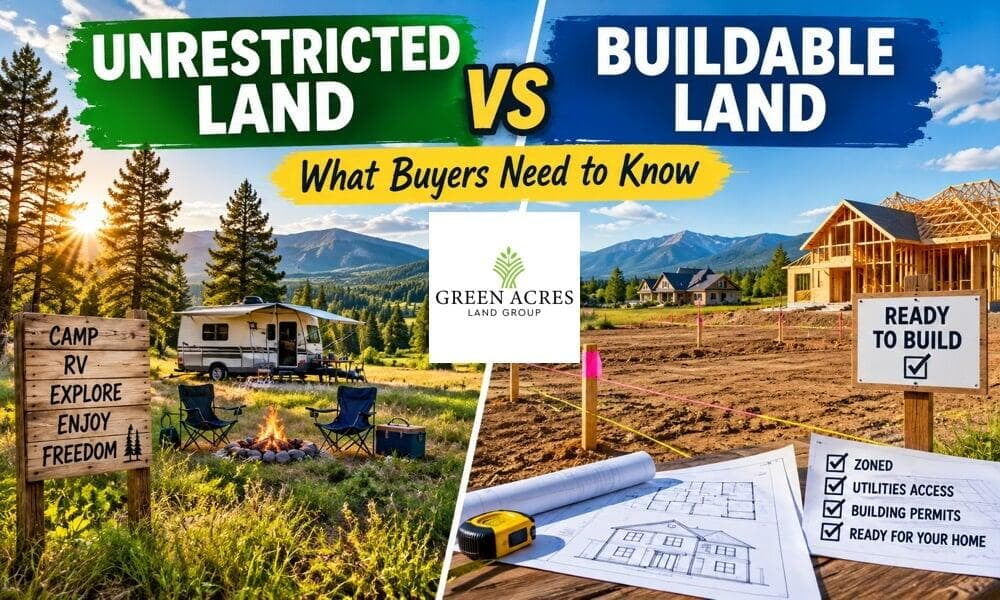
Here's the Big Difference
Think of it this way:
Unrestricted land is primarily about flexibility.
Buildable land is primarily about construction.
Those are two completely different questions.
One asks:
“How many restrictions are placed on what I can do with this property?”
The other asks:
“Can I legally build the structure I want on this property?”
And yes, one property can be both.
But it doesn't have to be.
A Property Can Be Unrestricted But NOT Buildable
Imagine finding a beautiful half-acre wooded parcel.
- No HOA.
- No deed restrictions.
- No neighborhood architectural committee.
Sounds unrestricted. 🌲
But then you discover:
The property doesn't have legal road access.
Or much of it is wetlands.
Or the lot isn't large enough under current zoning regulations.
Or the soil won't support the required septic system.
Suddenly, that “unrestricted” property might not work if your goal was to build a house.
That doesn't necessarily make it a bad property.
It simply means the property needs to match your intended use.
A Property Can Be Buildable But Very Restricted
Now imagine the opposite.
You find a residential lot in a developed subdivision.
Utilities are nearby.
The property is zoned correctly.
It's suitable for building.
Sounds perfect.
But then you discover the neighborhood has an HOA requiring:
- A minimum 2,000-square-foot home
- Certain exterior materials
- Approved house plans
- No RV parking
- No manufactured homes
- No detached workshops
- Landscaping requirements
The property may be perfectly buildable.
But it certainly isn't unrestricted.
Which One Should You Look For?
That depends entirely on what you want to do with the land.
If your goal is to:
Build a home
Focus heavily on whether the property is truly buildable.
If your goal is:
Recreational use, flexibility or holding land for the future
An unrestricted or lightly restricted parcel may be more appealing.
If you want:
Maximum flexibility AND the ability to build
Then ideally you're looking for property that qualifies as both.
That's why one of the smartest questions you can ask yourself before buying land is:
“What do I actually want to do with this property?”
Not someday.
Not hypothetically.
What is your real plan?
Build?
Hold?
Camp occasionally?
Invest?
Retire there later?
Resell it?
Your answer should drive the type of property you purchase.
Don't Buy the Marketing. Buy the Land.
This is where buyers can get themselves into trouble.
Terms like:
“Unrestricted.”
“Buildable.”
“Off-grid.”
“RV friendly.”
“Ready to build.”
They all sound fantastic in an advertisement.
But don't rely solely on the description.
Verify what you are actually allowed to do.
That might mean calling the county zoning department, checking the property records, reviewing deed restrictions, confirming road access or speaking with a licensed contractor, surveyor or septic professional.
A 10-minute phone call before purchasing could save you thousands of dollars later.
The Bottom Line
When looking at vacant land for sale, don't assume unrestricted and buildable mean the same thing.
They don't.
Unrestricted usually refers to fewer private-use restrictions.
Buildable usually refers to the ability to construct a permitted structure, subject to local requirements.
The best property isn't necessarily the one with the fewest restrictions.
And it isn't necessarily the one that's easiest to build on.
It's the property that fits what YOU actually want to do with it.
That's the part that matters most. 🌎
Ask questions.
Verify the details.
Know your intended use.
Then buy the dirt that actually fits your plan.
Because land can be one of the simplest forms of real estate to own...
But only if you understand exactly what you're buying.
Got questions? We’re here to help you find the perfect fi


