

And Why It’s Even More Powerful in Today’s Economy
And Why It’s Even More Powerful in Today’s Economy
In a world obsessed with stocks, crypto, rental properties, and the latest “hot” investment trend, raw land investing quietly sits in the background—often overlooked, misunderstood, and wildly underappreciated. That’s exactly why it deserves your attention.
Raw land isn’t flashy. It doesn’t come with granite countertops, tenants, or Instagram-worthy interiors. But what it does offer—especially in today’s economic climate—is simplicity, stability, and long-term upside that many traditional investments struggle to match.
Let’s break down why raw land has always been a strong investment—and why right now may be one of the best times in decades to own it.
1. Land Is the Original Limited Asset
They aren’t making any more of it.
That old saying gets repeated because it’s true—and increasingly important. Land is a finite asset. As population grows, development expands, and desirable areas become crowded, raw land naturally becomes more valuable over time.
Unlike stocks that can be diluted or companies that can fail, land doesn’t disappear. It doesn’t go bankrupt. It doesn’t get replaced by a newer version.
Scarcity alone makes land powerful. Scarcity plus long-term demand makes it lucrative.
2. No Tenants, No Toilets, No Termites
One of the biggest advantages of raw land is what it doesn’t have.
- No tenants calling at midnight
- No repairs or maintenance
- No roofs, plumbing, or appliances
- No evictions
- No insurance headaches
- Land just… sits there. Quietly.
That simplicity is incredibly attractive in a world where real estate investors are getting burned by rising repair costs, stricter tenant laws, higher insurance premiums, and shrinking margins.
Raw land is low-stress by design.
3. Land Is a Powerful Hedge Against Inflation
- Inflation eats away at cash. It erodes purchasing power. It makes “safe” money slowly unsafe.
- Land, on the other hand, tends to hedge against inflation—and often outperform it.
- As the cost of materials, labor, housing, and development rises, the underlying land beneath those projects becomes more valuable. Even if land isn’t producing income today, it often appreciates as the cost to replace or develop it increases.
- In inflationary environments, tangible assets like land historically outperform paper assets because they hold real, intrinsic value.
4. Today’s Economy Favors Simplicity and Patience
We’re living in a unique moment.
- High interest rates
- Expensive housing
- Volatile stock markets
- Increased economic uncertainty
- Burnout from over-leveraged investments
This environment rewards investors who are patient, flexible, and not overextended.
- Raw land fits that profile perfectly.
- You don’t need leverage to own it.
- You’re not forced to “make it cash flow” immediately.
- You can hold it long-term without pressure.
- In uncertain times, assets with low carrying costs and no urgency become incredibly valuable.
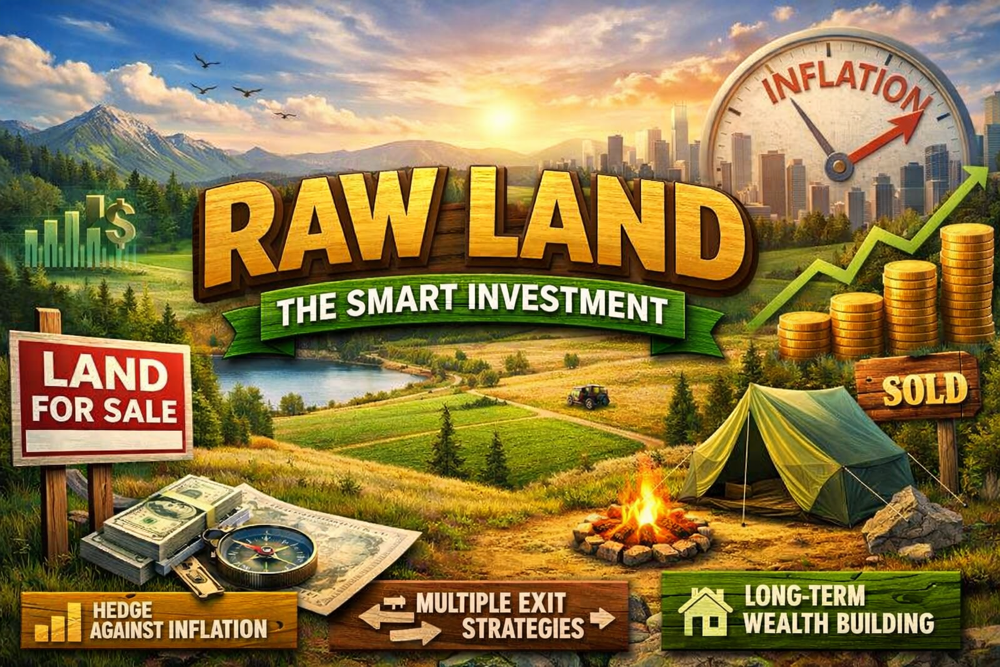
5. Land Has Multiple Exit Strategies
One of the biggest misconceptions about raw land is that it’s “illiquid” or “hard to use.”
In reality, land offers multiple exit strategies.
- Hold long-term for appreciation
- Sell when demand increases
- Resell on owner financing
- Use recreationally (camping, RV, weekends)
- Build later when conditions are right
You’re not locked into a single strategy. Land gives you options—and optionality is powerful in unpredictable markets.
6. Affordable Entry Compared to Traditional Real Estate
In many markets, buying a rental property now requires large down payments, high monthly payments, tight margins, and significant risk.
Raw land often allows investors to enter at a much lower price point, diversify across multiple parcels, and avoid putting all their capital into one highly leveraged deal.
Lower entry cost means lower risk—and more flexibility.
7. Demand Is Quietly Growing
While headlines focus on housing shortages, something else is happening beneath the surface.
- More people want space
- More people value privacy
- More people want off-grid or recreational options
- More people want assets outside traditional systems
Remote work, lifestyle shifts, and long-term planning are driving renewed interest in land—especially in affordable, accessible areas.
This demand doesn’t always make the news, but it shows up in rising prices, shrinking inventory, and faster sales.
The Bottom Line
Raw land isn’t about quick flips or overnight riches.
- It’s about long-term wealth building through owning something real in an increasingly unstable world.
- It’s about patience over pressure.
- It’s about simplicity over complexity.
- It’s about playing the long game.
In today’s economic climate—where volatility is high and certainty is low—raw land offers something rare.
Peace of mind with upside.
Got questions? We’re here to help you find the perfect fit.


