

4 Great States for Raw Land Growth and Opportunity
4 Great States for Raw Land Growth and Opportunity
A lot of people talk about land like it is one big category. It’s not.
Where you buy matters. A lot.
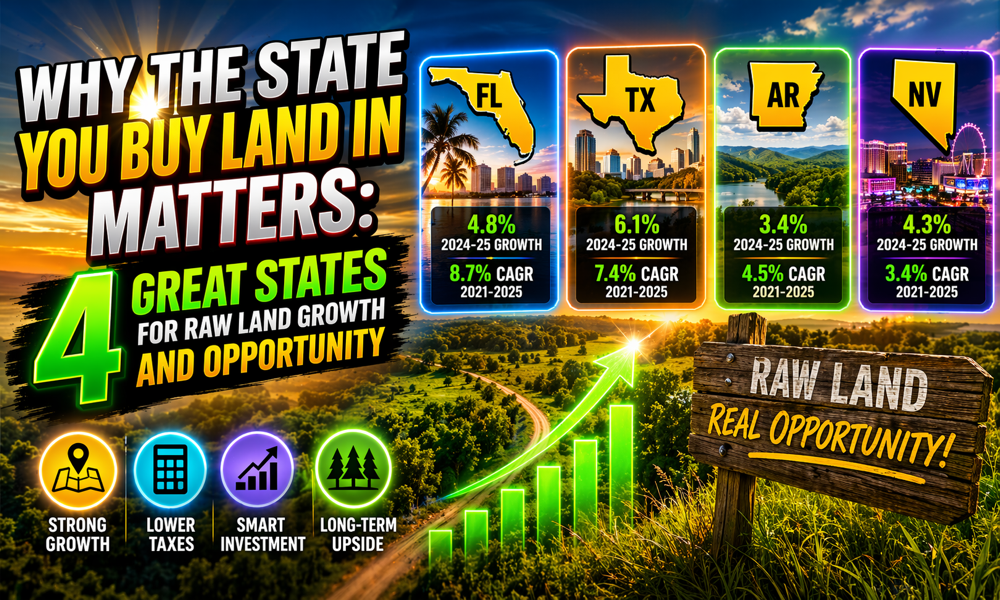
Based on USDA’s 2021 and 2025 state land values, below are growth rates for 4 states that present a strong investment case.
- Florida: 8.7% per year
- Texas: 7.4% per year
- Arkansas: 4.5% per year
- Nevada: 3.4% per year
The state you choose affects your upside, your tax exposure, your buyer pool, your resale speed, and how much room you have for appreciation. Two properties that look similar on paper can perform very differently if one sits in a state with stronger population growth, friendlier taxes, and better long-term demand.
One important caveat before we get into the numbers: there is no perfect national database for every kind of “raw land.” The cleanest statewide benchmark is USDA’s farm real estate value series, which measures the value of land and buildings on farms. So this is best used as a state-level proxy for land trends, not a direct pricing guide for every vacant residential lot, rural recreational parcel, or infill homesite. USDA explicitly defines farm real estate value as the value of all land and buildings used for agricultural production and excludes Alaska and Hawaii from the 48-state series.
That said, if you want to understand why Florida, Texas, Arkansas, and Nevada are worth watching, the numbers tell a pretty clear story.
Florida: strong growth, strong demand, strong tailwinds
Florida remains one of the strongest land-opportunity states because demand keeps showing up. The state’s population was up 8.9% from April 2020 to July 2025, according to the Census Bureau. That is a huge tailwind for land over time because more people ultimately means more pressure on housing, services, and development corridors.
On the land-value side, USDA’s farm real estate benchmark for Florida rose 4.8% from 2024 to 2025, and the implied compound annual growth rate from 2021 to 2025 was about 8.7% per year. That is a very strong multiyear clip.
Florida also benefits from having no state individual income tax, which is one of the reasons it continues to attract both residents and capital. For land investors, that matters because it supports migration, retirement demand, and second-home interest.
Florida is not cheap, and that is the downside. But if your thesis is long-term demand, lifestyle appeal, and population-driven land pressure, Florida is still one of the strongest plays.
Texas: scale, business migration, and consistent land appreciation
Texas has a lot going for it. It is large, economically diverse, business-friendly, and still attracting people at scale. Census QuickFacts shows Texas population growth of 8.8% from April 2020 to July 2025, basically right in line with Florida.
USDA’s statewide land proxy for Texas rose 6.1% from 2024 to 2025, and the 2021-2025 CAGR works out to about 7.4% per year. That is not random. It suggests Texas has had both near-term momentum and a solid multiyear trend.
Like Florida, Texas has no state individual income tax. That does not magically make every parcel a great deal, but it does help support business formation, inbound migration, and overall economic competitiveness.
Why does that matter for land? Because land usually wins when people, jobs, and development keep expanding outward. Texas gives you a broad range of strategies too: path-of-growth land, rural recreational land, outskirts development plays, and lower-cost long-hold parcels.
If Florida is the lifestyle-and-migration land story, Texas is the scale-and-growth land story.
Arkansas: less hype, lower entry points, and a quieter opportunity
Arkansas is not as flashy as Florida or Texas, and that is exactly why it can be interesting.
The state’s population grew 3.4% from April 2020 to July 2025. That is slower than Florida and Texas, but still positive. More importantly, Arkansas land values have been moving without the same level of national attention. USDA’s farm real estate benchmark for Arkansas rose 3.4% from 2024 to 2025, and its 2021-2025 CAGR was about 4.5% per year.
That makes Arkansas attractive for a different reason: entry price and risk profile. It has not been bid up the way hotter Sun Belt states have. For investors who care about buying at a more reasonable basis, that matters. A quieter market with slower but steady appreciation can still be a very good land market.
Arkansas also became more tax-competitive in 2026, with its top individual income tax rate reduced to 3.99%. It is not a no-income-tax state, but it is moving in a friendlier direction.
So Arkansas is not the sexy headline market. It is the “buy lower, stay patient, and let the math work” market.
Nevada: lower basis, population growth, and tax advantages
Nevada is another interesting one because it offers a different setup than Florida or Texas.
Census QuickFacts shows Nevada’s population up 5.7% from April 2020 to July 2025. That is a meaningful growth number, especially for a state with major metro influence from Las Vegas and Reno and a lot of surrounding land inventory.
USDA’s statewide land proxy for Nevada rose 4.3% from 2024 to 2025, and the 2021-2025 CAGR comes out to about 3.4% per year. That is slower than Florida and Texas, but Nevada has another advantage: a lower starting basis than many coastal markets, which can make land deals more accessible.
Nevada also has no state individual income tax, which helps keep it attractive for relocation and investment.
Got questions? We’re here to help you find the perfect fit.


